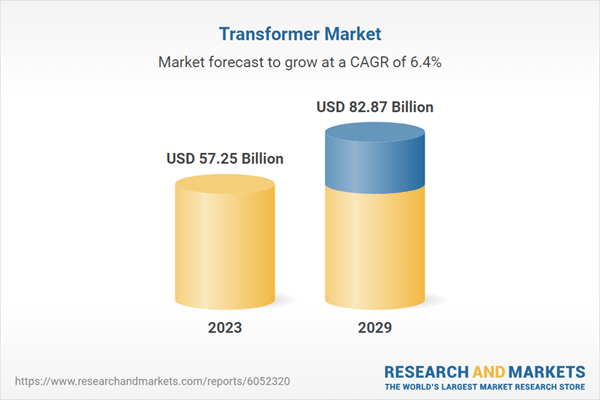
The Transformer Market was valued at USD 57.25 billion in 2023, and is projected to reach USD 82.87 billion by 2029, rising at a CAGR of 6.36%.
Recent Developments in the Global Transformer Market
Recent Product Launches
- In 2023, Hitachi Energy launched a digital monitoring platform for transformers, enhancing performance monitoring and predictive maintenance capabilities.
- In 2023, Siemens Energy introduced a new range of eco-friendly transformers designed to reduce greenhouse gas emissions, aligning with global sustainability goals.
Mergers and Acquisitions
- In June 2024, Italian transmission system operator (TSO) Terna signed an agreement with Acea, a utility company, to acquire high-voltage grid assets, including aerial and underground lines, substation components, and a fiber optic network in Rome. These assets will be transferred to a newly formed company, NewCo, owned by Terna, following contributions from Areti, Acea’s distribution system operator (DSO).
- WEG agreed to acquire Volt Electric Motor, a Turkish manufacturer of industrial and commercial electric motors and a subsidiary of the Saya Group in September 2024. The acquisition, valued at USD 88 million (Enterprise Value), will be finalized following customary adjustments and is aimed at expanding WEG’s market presence. With the acquisition, the company will expand its presence in the region and diversify its industrial presence to serve Turkey and all of Europe.
- In September 2024, Prolec GE Waukesha, Inc., a business unit of Prolec GE, acquired the remaining equity stake in Menk USA LLC, a North American manufacturer of cooling radiators for power grid transformers. Prolec GE Waukesha, a partial owner since 2002, purchased the remaining shares from Germany-based Menk-Schmehmann Group. This acquisition integrates Menk USA into Prolec GE's components portfolio, strengthening its supply chain resiliency and strategic capabilities.
- In November 2024, TE Connectivity, a global manufacturer of connectors and sensors, acquired Harger, a company focused on lightning protection and grounding solutions for IEEE markets. This acquisition strengthens TE’s energy business unit by enhancing its portfolio of grid reliability and connectivity solutions for renewable power, utilities, and industrial applications, particularly in solar farms' electrical balance of systems (EBoS).
- In December 2024, RESA Power, LLC, a company specializing in power systems electrical testing, transformer services, and life extension solutions for power distribution equipment, acquired Power Asset Recovery Corporation (PARC). This marks RESA Power's eighth acquisition in 2024 and the thirteenth since partnering with Investcorp in early 2022.
MARKET DRIVERS & OPPORTUNITIES
Growing Outlook of Digitalization in Transformers
The integration of digital technologies, such as IoT-enabled sensors and real-time monitoring systems, is transforming the global transformer market. Digital transformers are designed to improve efficiency, reliability, and maintenance processes, supporting the increasing demand for smart grid solutions. For instance, field trials of companies such as Prolec and Ubicquia’’s smart transformers across North America have demonstrated their ability to provide real-time insights into transformer health and performance. In 2023, Prolec and Ubicquia introduced smart transformers with UbiGrid, a monitoring platform that delivers real-time data and analytics to optimize operations and reduce downtime.
The Transformer 4.0 project also illustrates the role of digitalization in power transformers. It uses the Digital Twin (DT) concept to create a virtual version of the physical transformer, enhancing design, manufacturing, and maintenance processes. With AI and optimization tools, the project focuses on condition monitoring, predictive maintenance, and performance analysis throughout the transformer’s lifecycle. These developments reflect the growing focus on digitalization to meet the evolving needs of energy systems.
Rising Power Consumption Across the Globe
The increasing demand for electricity due to rapid industrialization and urbanization is driving the growth of the global transformer market. Investments in power infrastructure, particularly in developing economies, present significant growth opportunities. The BRICS nations - Brazil, Russia, India, China, and South Africa - experienced a notable surge in electricity consumption, with an overall increase of 6%. Among these, China and India saw the highest growth, with China’s consumption rising by 6.9% and India’s by 6.7%. This significant uptick in demand is reflective of the rapid industrialization and urbanization in these countries, which are placing increasing pressure on their power grids. These developments create a sustained need for transformers to support the expanding electricity networks, ensuring that the infrastructure can keep up with the heightened demand.
INDUSTRY RESTRAINTS
High Initial Costs
The high initial investment required for transformer manufacturing, installation, and maintenance poses a challenge in the transformer market, especially for smaller utilities and organizations in emerging markets. One major factor contributing to the high costs is the rising price of raw materials. Copper and grain-oriented electrical steel (GOES), two key materials used in transformer manufacturing, have experienced significant price increases. Copper prices have risen by nearly 40% since the pandemic, while GOES prices have nearly doubled. These materials constitute a substantial portion of the manufacturing cost, directly impacting the overall price of transformers.
SEGMENTATION INSIGHTS
INSIGHTS BY TYPE
The global transformer market is broadly segmented into distribution transformers, power transformers, and specialty transformers, each catering to distinct applications within power systems. Among these, distribution transformers held the largest revenue share. Their dominance is attributed to their extensive use in power distribution networks, where they step down high-voltage electricity from transmission lines to levels suitable for residential, commercial, and industrial end-users. The increasing demand for electricity in urban and rural areas, coupled with ongoing electrification projects in developing regions, continues to drive the widespread adoption of distribution transformers. Additionally, the modernization of aging distribution infrastructure in developed economies is further boosting the demand for efficient and reliable distribution transformers.
Power transformers, which are critical for high-voltage energy transmission over long distances, also account for a substantial share of the transformer market. Their demand is particularly fueled by the growing integration of renewable energy projects, such as wind and solar farms, into national grids. These transformers play a pivotal role in connecting renewable energy sources to the transmission network, ensuring efficient and stable power delivery. The global push towards decarbonization and the expansion of cross-border electricity trade is also contributing to the rising demand for power transformers with high-capacity ratings and improved efficiency.
Segmentation by Type
- Distribution Transformers
- Power Transformers
- Others
INSIGHTS BY VOLTAGE
The global transformer market by voltage is segmented into low voltage, medium voltage, and high voltage. Medium-voltage transformers held the largest share in 2023, mainly due to their use in industrial and commercial settings. These transformers are commonly found in manufacturing, construction, and commercial buildings, where they ensure a steady power supply. Furthermore, low-voltage transformers are mainly used in residential areas and small businesses. They deliver electricity at safe voltage levels for homes, offices, and small commercial spaces. The demand for these transformers is growing with urbanization and the increase in household energy use. Also, high-voltage transformers are used for long-distance power transmission and large energy projects. They help transmit electricity efficiently from power plants to distant locations. Their demand is increasing due to renewable energy projects and the need for expanded power transmission networks.
Segmentation by Voltage
- Low Voltage
- Medium Voltage
- High Voltage
INSIGHTS BY INSULATION
The liquid-immersed insulation segment holds the largest share of the global transformer market in 2023. These transformers are widely used in utility-scale power distribution and transmission systems due to their higher efficiency and superior cooling capabilities. Liquid insulation, typically mineral oil or synthetic alternatives, effectively dissipates heat, allowing these transformers to handle larger loads and operate under high-stress conditions. Their robust performance makes them suitable for industrial facilities, power plants, and renewable energy installations where reliability is critical.
Furthermore, dry-type transformers are gaining popularity in specific applications due to their enhanced safety features and lower maintenance requirements in the global transformer market. Unlike liquid-immersed transformers, dry-type transformers use air or solid insulation, eliminating the risk of oil leaks and fire hazards. These transformers are increasingly used in environments where fire safety and environmental concerns are priorities, such as commercial buildings, residential complexes, and sensitive indoor facilities like hospitals and data centers. Additionally, their low maintenance needs and ability to withstand harsh conditions make them appealing for certain industrial and urban settings.
Segmentation by Insulation
- Liquid Immersed
- Dry Type Transformers
INSIGHTS BY PHASE
Three-phase transformers hold the largest global transformer market share, as these transformers are widely used in industrial and commercial settings due to their ability to efficiently handle high power loads. Three-phase transformers support critical infrastructure, such as manufacturing plants, power distribution networks, and large commercial complexes. Their design ensures a balanced power supply, reduced energy losses, and better efficiency in transmitting electricity over long distances, making them essential in medium to high-voltage applications. Furthermore, single-phase transformers primarily serve residential and small-scale applications, where power requirements are lower. They are commonly used in household power distribution systems, rural electrification projects, and smaller commercial establishments. Single-phase transformers are cost-effective for localized power needs, offering a practical solution for areas with minimal electricity demand.
Segmentation by Phase
INSIGHTS BY END USER
The global transformer market is segmented based on end-user categories, with industrial, residential, commercial, and others driving demand. Among these, the industrial segment is anticipated to account for the largest revenue share in 2023. This growth is primarily attributed to the rising need for reliable and uninterrupted power supply in manufacturing and heavy industries. These industries, including steel, automotive, chemical, and oil & gas, depend heavily on transformers to ensure stable and efficient power distribution for their energy-intensive operations. With global industrialization accelerating, particularly in emerging economies, the demand for advanced transformer solutions tailored to high-capacity and specialized requirements continues to grow.
Furthermore, the residential segment is also experiencing steady growth in the global transformer market, supported by urbanization and the increasing consumption of energy in households. Expanding urban areas, the construction of new residential complexes, and a rising standard of living contribute to the heightened demand for electricity, driving the adoption of transformers for localized distribution. Also, the shift towards smart homes, energy-efficient appliances, and renewable energy sources, such as rooftop solar panels, is necessitating the use of smaller, more efficient transformers capable of handling distributed energy generation and storage.
Segmentation by End-User
- Industrial
- Residential
- Commercial
- Others
