The global battery management system market size is estimated to grow from USD 8.1 billion in the current year to USD 37.1 billion by 2035, at a CAGR of 14.8% during the forecast period till 2035.
The opportunity for battery management system market has been distributed across the following segments:
Type of Battery
- Motive Batteries
- Stationary Batteries
Technology
- Lithium-ion Batteries
- Lead-acid Batteries
- Nickle-cadmium Batteries
- Others
Topology
- Centralized
- Distributed
- Modular
Component
Application Area
- Computing Devices
- Electric Vehicles
- Renewable Energy Systems
- Industrial Devices
- Other Applications
End-User
- Automotive Industry
- Renewable Energy Industry
- Telecommunications Industry
- Others
Geography
- North America
- Europe
- Asia-Pacific
- Latin America
- Middle East and Africa
Battery Management System Market: Growth and Trends
A battery management system (BMS) is a technology designed to oversee and control the performance of a battery pack. A battery pack consists of multiple cells arranged either in series or parallel to provide power for electronics and vehicles. Since every single cell plays a role in the total power output, it is crucial to monitor the operating conditions of these cells to ensure optimal performance and value.
While the technology is relevant to the entire battery pack, the monitoring and control functions are mainly focused on each individual cell. Additionally, battery management systems provide safety by preventing the battery from operating outside its safe operating area (SOA).
Till now, various technologies have been employed to produce different types of batteries, such as lead-acid, nickel-cadmium, nickel-metal hydride, and lithium-ion (Li-ion) batteries. Current Li-ion batteries in portable electronic devices face challenges in meeting the necessary energy density and safety requirements, particularly in high energy-dense applications like electric vehicles (EVs) and energy storage systems. Implementing battery management systems on a larger scale in stationary energy storage could aid in leveraging the significant potential of renewable energy sources.
Furthermore, the growing concern regarding global warming has created a demand for countries to achieve stringent CO2 emission targets. The transportation sector is a significant contributor to CO2 emissions, accounting for over 25% of the total emissions worldwide. To reduce CO2 levels, countries around the globe are increasingly turning their attention to electric vehicle battery management systems, which represents a burgeoning area of interest for stakeholders in this market.
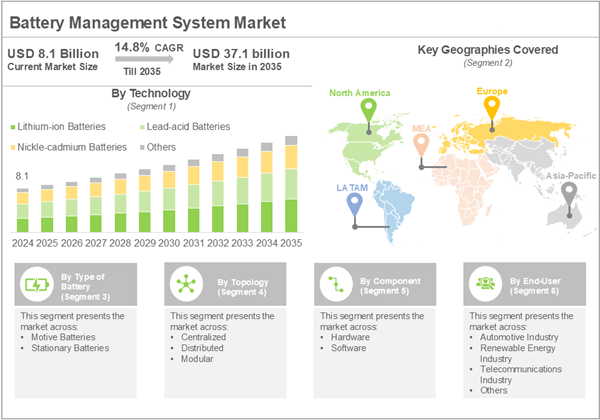
Battery Management System Market: Key Segments
Market Share by Type of Battery
Based on the type of battery, the global battery management system market is segmented into motive batteries and stationary batteries. According to our estimates, currently, motive batteries segment captures the majority share of the market. This can be attributed to the fact that motive batteries are widely used in electric vehicles, which serves as a key application area for battery management technology.
Market Share by Technology
Based on technology, the battery management system market is segmented into Lithium-ion batteries, Lead-acid batteries, Nickle-cadmium batteries and others. According to our estimates, currently, Lithium-ion batteries capture the majority share of the market. Notably, in recent years, lithium-ion batteries have become increasingly popular in compact consumer electronics, such as smartphones, laptops, and power tools, contributing to their significant market share.
Market Share by Topology
Based on topology, the battery management system market is segmented into centralized, distributed and modular topologies. According to our estimates, currently, centralized battery management systems capture the majority share of the market. This can be attributed to the small size, affordability, and ease of use, which makes it appealing to end-users.
Market Share by Application Area
Based on application area, the battery management system market is segmented into computing devices, electric vehicles, industrial devices, renewable energy systems and other applications. According to our estimates, currently, electric vehicle battery management system and this trend is unlikely to change in future as well.
Market Share by End-User
Based on end-user, the battery management system market is segmented into automotive industry, renewable energy industry, telecommunications industry and others. According to our estimates, currently, automotive battery management system captures the majority share of the market.
However, driven by the rising demand for renewable energy sources and the recent transition from fossil fuels to green energy, the market for battery management systems utilized in the renewable energy sector is anticipated to grow at a CAGR during the forecast period.
Market Share by Geography
Based on geography, the battery management system market is segmented into North America, Europe, Asia, Latin America, Middle East and North Africa, and Rest of the World. According to our estimates, currently, Asia captures the majority share of the market. However, market in North America is anticipated to experience the highest CAGR during the forecast period
Battery Management System Market: Research Coverage
The report on the battery management system market features insights on various sections, including:
- Market Sizing and Opportunity Analysis: An in-depth analysis of the battery management system market, focusing on key market segments, including type of battery, technology, topology, component, application area, end user, and geography.
- Competitive Landscape: A comprehensive analysis of the companies engaged in the battery management system market, based on several relevant parameters, such as year of establishment, company size, location of headquarters, type of battery, technology, topology, component, application area, and end user.
- Company Profiles: Elaborate profiles of prominent players engaged in the battery management system market, providing details on location of headquarters, company size, company mission, company footprint, management team, contact details, financial information, operating business segments, battery management system portfolio, moat analysis, recent developments, and an informed future outlook.
- Patent Analysis: An insightful analysis of patents filed / granted in the battery management system market, based on relevant parameters, including type of patent, patent publication year, patent age and leading players.
- Porter’s Five Forces Analysis: An analysis of five competitive forces prevailing in the battery management system market, including threats of new entrants, bargaining power of buyers, bargaining power of suppliers, threats of substitute products and rivalry among existing competitors.
- SWOT Analysis: An insightful SWOT framework, highlighting the strengths, weaknesses, opportunities and threats in the domain. Additionally, it provides Harvey ball analysis, highlighting the relative impact of each SWOT parameter.
1. PREFACE
2. RESEARCH METHODOLOGY
3. ECONOMIC AND OTHER PROJECT SPECIFIC CONSIDERATIONS
4. MACRO-ECONOMIC INDICATORS
5. EXECUTIVE SUMMARY
6. BATTERY MANAGEMENT SYSTEM MARKET: MEGATRENDS
7. INTRODUCTION
8. BATTERY MANAGEMENT SYSTEM MARKET: VALUE CHAIN ANALYSIS
9. COMPETITIVE LANDSCAPE: LEADING PLAYERS IN THE BATTERY MANAGEMENT SYSTEM MARKET
10. STARTUP ECOSYSTEM IN THE BATTERY MANAGEMENT SYSTEM MARKET
11. PATENT ANLYSIS
12. MARKET IMPACT ANALYSIS: DRIVERS, RESTRAINTS, OPPORTUNITIES AND CHALLENGES
13. GLOBAL BATTERY MANAGEMENT SYSTEM MARKET
14. BATTERY MANAGEMENT SYSTEM MARKET, BY TYPE OF BATTERY
15. BATTERY MANAGEMENT SYSTEM MARKET, BY TECHNOLOGY
16. BATTERY MANAGEMENT SYSTEM MARKET, BY TOPOLOGY
17. BATTERY MANAGEMENT SYSTEM MARKET, BY COMPONENT
18. BATTERY MANAGEMENT SYSTEM MARKET, BY APPLICATION AREA
19. BATTERY MANAGEMENT SYSTEM MARKET, BY END-USER
20. NORTH AMERICA BATTERY MANAGEMENT SYSTEM MARKET
21. EUROPE BATTERY MANAGEMENT SYSTEM MARKET
22. ASIA-PACIFIC BATTERY MANAGEMENT SYSTEM MARKET
23. LATIN AMERICA BATTERY MANAGEMENT SYSTEM MARKET
24. MIDDLE EAST AND AFRICA BATTERY MANAGEMENT SYSTEM MARKET
25. COMPANY PROFILES
26. PORTER’S FIVE FORCES ANALYSIS
27. EXECUTIVE INSIGHTS
28. APPENDIX 1: TABULATED DATA
29. APPENDIX 2: LIST OF COMPANIES AND ORGANIZATIONS
