The global semiconductor market size is estimated to grow from USD 623 billion in 2025, to USD 1.07 trillion by 2035, at a CAGR of 5.08% during the forecast period, to 2035.
Opportunities in the semiconductor market have been distributed across the following segments:
Type of Component
- Memory Devices
- Logic Devices
- Analog ICs
- MPU
- Others
Technology
- MOSFET
- FinFET
- Gate-First
- Gate-Last
- 3D Stacked
- Others
Type of Packaging
- System-in-Package (SiP)
- System-on-Chip (SoC)
- System-on-Module (SoM)
- Chip-on-Board (COB)
- Chip-on-Flex (COF)
- Others
Power Consumption
- Low Power Devices
- High Power Devices
- Ultra-Low Power Devices
- Ultra-High Power Devices
Type of Memory Device
- DRAM
- SRAM
- Flash Drives
- ROM
- Others
Application Area
- Telecommunication
- Defense and Military
- Industrial
- Consumer Electronics
- Automotives
- Others
Node Size
- 16/14 nm
- 10/7 nm
- 7/5 nm
- 65 nm
- Other Sizes
Type of Fabrication Material
Geographical Regions
- North America
- Europe
- Asia-Pacific
- Latin America
- Middle East and Africa
Growth and Trends
The fourth industrial revolution, known as Industry 4.0, is transforming the operations of manufacturing, production, and businesses globally through the integration of intelligent computers and connected devices. Over time, there has been a growing global demand for electronic products, data center chips, integrated circuits, batteries, and more, aimed at simplifying human life.
As a result, manufacturers are continuously using silicon and other materials to create discrete semiconductors, which are essential components in electronic devices. Semiconductors, often referred to as wafer chips, play a vital role in today's world by forming the foundation of functionality for a range of consumer products, such as smartphones, televisions, and computers.
From construction to aerospace and the telecommunications sector, semiconductors are utilized across diverse fields; automotive technologies, such as stability control and traction control systems, employ advanced micro-integrated circuits and memory integrated circuits to enhance vehicle safety and performance. An analysis of the global semiconductor industry reveals a strong recovery following the pandemic, after a difficult 2023, with the market growth forecast indicating a notable annual increase.
Major trends in the semiconductor market include:
- Growing demand fueled by generative AI.
- Integration of virtual reality into smart manufacturing.
- Cloud computing and cutting-edge automotive technologies that are anticipated to transform the semiconductor supply chain.
Moreover, the semiconductor market outlook for the current year indicates a positive climate for innovation and investment, as companies adjust to changing semiconductor technology trends and an increased reliance on logic integrated circuits.
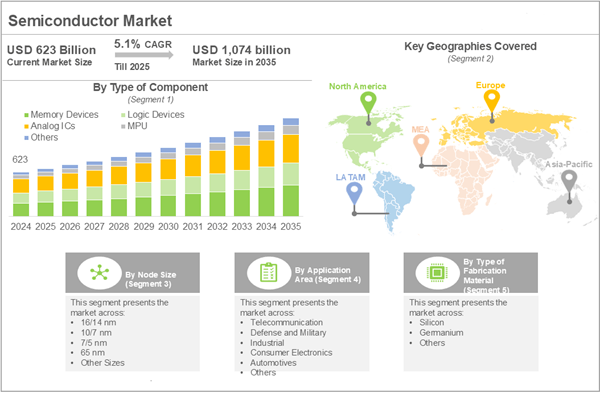
Semiconductor Market: Key Segments
Market Share by Type of Component
Based on the type of component, the global semiconductor market is segmented into memory devices, logic devices, analog ICs, MPU, and others. According to estimates, currently, memory devices segment captures the majority share of the market. However, fueled by the increasing demand for smart devices such as smartphones, smartwatches, and smart televisions, the market for analog ICs and other innovative semiconductor technologies is projected to experience a higher compound annual growth rate (CAGR) during the forecast period.
Market Share by Technology
Based on technology, the semiconductor market is segmented into MOSFET, FinFET, Gate-First, Gate-Last, 3D stacked, and others. According to estimates, currently, the metal oxide semiconductor field effect transistors(MOSFET) segment captures the majority share of the market. However, due to the lower current leakage associated with fin-field effect transistors (FinFET), which enables them to function with reduced power consumption, the FinFET technology market is projected to experience a higher CAGR throughout the forecast period, creating new opportunities within the semiconductor supply chain.
Market Share by Type of Packaging
Based on type of packaging, the semiconductor market is segmented into System-in-Package (SiP), System-on-Chip (SoC), System-on-Module (SoM), Chip-on-Board (COB), Chip-on-Flex (COF) and others. According to estimates, currently, system-on-chip (SoC) segment captures the majority share of the market. However, due to the flexibility and customization optiopakans they offer, the market for SoP packaging is anticipated to experience a higher compound annual growth rate (CAGR) throughout the forecast period.
Market Share by Type of Memory Devices
Based on type of memory devices, the semiconductor market is segmented into DRAM, SRAM, flash drives, ROM and others. According to estimates, currently, DRAMs segment captures the majority share of the market. However, due to the quicker data transfer rates provided by SRAM, the market for SRAM devices is anticipated to grow at a higher CAGR during the forecast period.
Market Share by Application Area
Based on application area, the semiconductor market is segmented into telecommunication, defense and military, industrial, consumer electronics, automotives, and others. According to estimates, currently, semiconductors used in telecommunication devices capture the majority share of the market. This can be attributed to the launch of 5G technology, which allows for high-speed data transmission with reduced latency among various cloud-connected devices.
Market Share by Node Size
Based on node size, the semiconductor market is segmented into 16/14 nm, 10/7 nm, 7/5 nm, 65 nm, and others. According to estimates, currently, the node size of 16/14 nm captures the majority share of the market. However, owing to the growing demand for more compact transistor chips, the market for semiconductors sized at 7/5nm is projected to expand at a higher CAGR during the forecast period.
Market Share by Type of Fabrication Material
Based on the type of fabrication material, the semiconductor market is segmented into silicon, germanium, and others. According to estimates, currently, silicon-based semiconductors capture the majority share of the market. This is primarily due to its ease of purification, its abundant availability, and the stability of the element's structure.
Market Share by Geography
Based on geography, the semiconductor market is segmented into North America, Europe, Asia, Latin America, the Middle East and North Africa, and the Rest of the World. According to estimates, currently, Asia-Pacific captures the majority share of the market. However, North America is anticipated to grow at a higher CAGR during the forecast period.
1. PROJECT BACKGROUND
2. RESEARCH METHODOLOGY
3. ECONOMIC AND OTHER PROJECT SPECIFIC CONSIDERATIONS
4. EXECUTIVE SUMMARY
5. SEMICONDUCTOR MARKET: MEGATRENDS ANALYSIS
6. INTRODUCTION
7. SEMICONDUCTOR MARKET: VALUE CHAIN ANALYSIS
8. COMPETITIVE LANDSCAPE: LEADING PLAYERS IN THE SEMICONDUCTOR MARKET
9. STARTUP ECOSYSTEM IN THE SEMICONDUCTOR MARKET
10. PATENT ANLYSIS
11. MARKET IMPACT ANALYSIS: DRIVERS, RESTRAINTS, OPPORTUNITIES AND CHALLENGES
12. GLOBAL SEMICONDUCTOR MARKET
13. SEMICONDUCTOR MARKET, BY TYPE OF COMPONENT
14. SEMICONDUCTOR MARKET, BY TECHNOLOGY
15. SEMICONDUCTOR MARKET, BY TYPE OF PACKAGING
16. SEMICONDUCTOR MARKET, BY POWER CONSUMPTION
17. SEMICONDUCTOR MARKET, BY TYPE OF MEMORY DEVICES
18. SEMICONDUCTOR MARKET, BY APPLICATION AREA
19. SEMICONDUCTOR MARKET, BY NODE SIZE
20. SEMICONDUCTOR MARKET, BY TYPE OF FABRICATION MATERIAL
21. NORTH AMERICA SEMICONDUCTOR MARKET
22. EUROPE SEMICONDUCTOR MARKET
23. ASIA-PACIFIC SEMICONDUCTOR MARKET
24. LATIN AMERICA SEMICONDUCTOR MARKET
25. MIDDLE EAST AND AFRICA SEMICONDUCTOR MARKET
26. COMPANY PROFILES
27. PORTER’S FIVE FORCES ANALYSIS
28. EXECUTIVE INSIGHTS
29. APPENDIX 1: TABULATED DATA
30. APPENDIX 2: LIST OF COMPANIES AND ORGANIZATIONS
