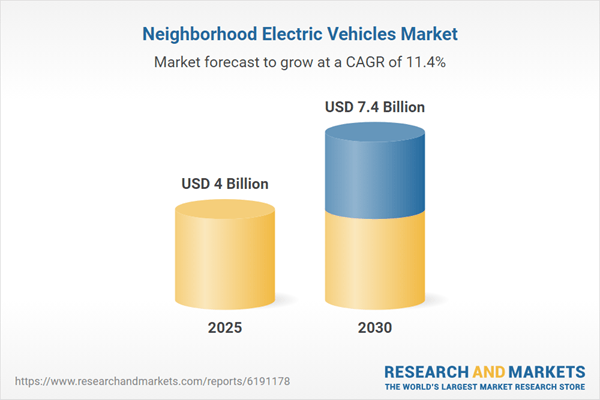
The global automotive industry is transitioning significantly from producing gas-powered vehicles to EVs. While EVs have been in the market for a long time, advances in technological innovation and an inclination toward green mobility solutions have substantially fueled their global demand. NEVs are part of EVs, which are ideal for the worldwide shift toward clean transportation and are expected to benefit from improvements in battery life and demand for eco-friendly transport. Compact, affordable and efficient, NEVs serve short-distance travel in communities and campuses. Rising EV penetration encourages NEV adoption by promoting battery technology, cost reduction and charging facilities.
These advances are driving down the cost of NEVs, making them more energy efficient and helping to increase their presence in communities, college campuses, downtown districts and more as a green alternative transportation choice. With increased sustainable goals, NEVs are expected to be an important part of future urban transport.
Report Scope
The global neighborhood electric vehicle (NEV) market is segmented by battery type and end-user segments. In this report, we have covered market analysis for the leading countries, such as the U.S., Canada, China, Japan, Germany, France and the U.K., where the opportunity for NEVs is gaining momentum in the global market. The regional analysis of NEVs covers North America; Europe; Asia-Pacific; and the Rest of the World, which includes South America, the Middle East and Africa (MEA).
The study also covers leading companies with company overviews, financial information, product types and key developments. The report includes patent analysis, regulations and a competitive landscape, which enables the reader to understand the competitive environment more precisely.
The report is prepared in an easy-to-understand format; tables and figures are included to illustrate historical, current and future market scenarios. The base year is 2024, while 2025 is an estimated year, and the market values are forecasted for five years through 2030. Market values are in $ million.
The report includes:
- In-depth analysis of the global markets for neighborhood electric vehicles (NEVs) also known as low-speed vehicles (LSVs)
- Analyses of the global market trends, with revenue data for 2024, estimates for 2025, forecasts for 2028 and 2029, and projected CAGRs through 2030
- Estimates of the market size and revenue growth prospects, accompanied by a market share analysis by battery type, end-user and region
- Facts and figures pertaining to market dynamics, technological advances, regulations, prospects, and the impact of various region- and industry-specific macroeconomic variables
- Insights derived from Porter’s Five Forces analyses
- Overview of sustainability trends and ESG developments, with emphasis on consumer attitudes, as well as the ESG risk ratings and practices of leading companies
- Patent review, featuring key granted and published patents
- Analysis of the industry structure, including companies’ market shares and rankings, strategic initiatives, M&A activity and a venture funding outlook
- Profiles of the leading companies
Chapter 1 Executive Summary
Chapter 2 Market Overview
Chapter 3 Market Dynamics
Chapter 4 Emerging Technologies and Developments
Chapter 5 Market Segment Analysis
Chapter 6 Competitive Intelligence
Chapter 7 Appendix
List of Tables
List of Figures
